
(Christian and Hindu quote)
Characteristically, I am the sort of person that relishes this mix of challenge and joy. I can link this disposition with a short reflection on the Eight Worldly Dhammas (conditions or concerns). What are these concerns which, at the same time, are also impermanent and changing? They are:
- Gain and Loss
- Pleasure and Pain
- Praise and Blame
- Fame and Disrepute (status/disgrace)
One can frame them as preoccupations that we all crave and cling to, which keep us in samsara (the cycle of birth and death). These Dhammas lead away from freedom and are therefore problematic. Personally, I have a deep, driving desire to be free. I believe that being aware of my response to these Dhammas and working with them leads to a freer attitude to life.
They are framed as opposites and on first glance might be divided into ‘goodies’ and ‘baddies’. For example, I would like pleasure and praise but not blame or pain. I strive to gain, but also try to avoid loss. I try to attract things that I perceive will bring me happiness and avoid things that I assume will bring me pain. These are my automatic responses to the events that happen in my life.
Unfortunately, all that glitters is not gold. My vision is faulty – I am under no illusion here! If all I had were the perceived positives – status, pleasure and so forth – then I would be at a spiritual dead- end. How many famous people die of substance misuse? The papers are full of the unhappiness of people who one might have thought had a surfeit of pleasure and success. It appears that if you do have many of these perceived positives, when anything bad happens, you might not have the resources to deal with it.
Could it be that the perceived negatives in the Eight Worldly Dhammas are not as bad as they might appear? Certainly they are not worth the effort I often put in to avoid them! We have the opportunity to transform our relationship with these ‘negative’ conditions and to use our experiences to learn and grow. A cliché perhaps, but true none-the-less.
The Tibetan Buddhist tradition often refers to the cycle of birth and death as the ‘Ocean of Samsara’ and it is a good metaphor. Oceans have incredible depths and on the surface have waves. These waves go up and down and as they do so, we are tossed and thrown about. This is the nature of our existence. We may be having a really happy time and then everything crashes down and we are in despair. The dharma (the teachings of the Buddha) is often described as a boat or a raft which we grab onto to avoid being engulfed by the waves.
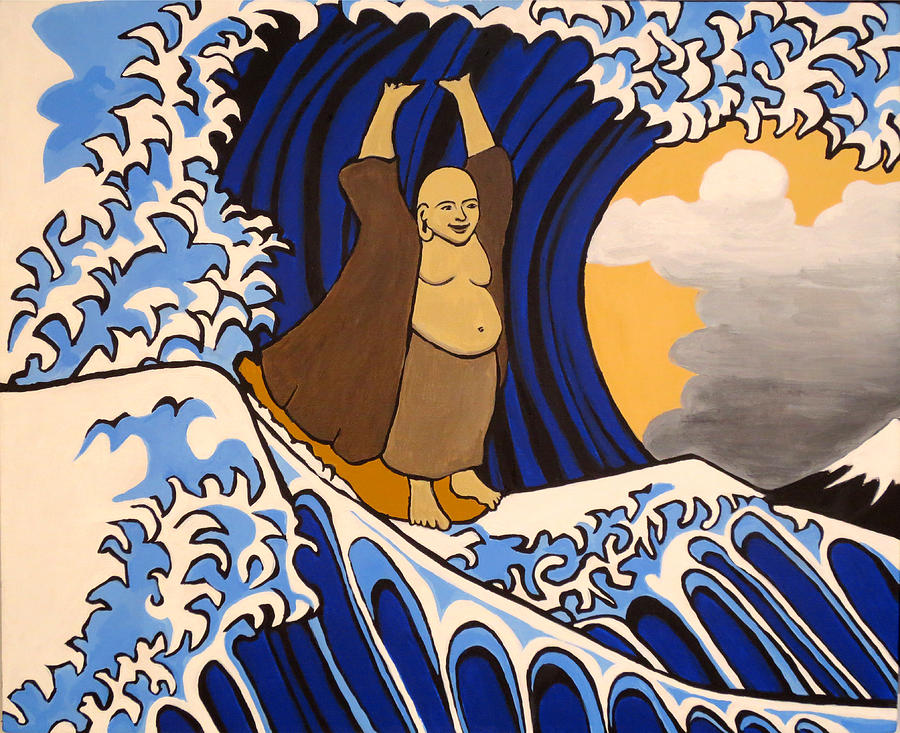
Perhaps we can see our journey through the ocean of the Eight Worldly Dhammas as a surfer would? We can ride the waves and a seasoned surfer, who knows how to go with the flow, wants to ride the big ones.
I hope to become more suspicious of the easy fix and perhaps spend more time welcoming (or at least accepting) the inevitable loss, pain and blame that may come my way! I can at least become less attached to these conditions when they arise and challenge my perceived sense of identity. Our identities are useful, but they are also transitory and make us feel smaller than I believe we really are.
And so it is, at the end of my first year, that I welcome further challenge and joy with as much openheartedness as I can!
With thanks to Jetsunma Tenzin Palmo
- Clare
Photo: ‘Tsumani Surfing Buddha’ by artist Nathan Winsor - check out his Buddhist-inspired paintings!