

“Go forth on your journey,
for the benefit of the many,
for the joy of the many,
out of compassion for the welfare,
the benefit and joy of all beings.”
- The Buddha
This week I want to write about the ‘work that reconnects’. This is a phrase that originates from Joanna Macy, a deep ecologist and Buddhist who has come up with many practices and methods that do just that; I have experienced Joanna’s Council of All Beings and the Truth Mandala through which I was invited to change and expand my perspective, and to open up to my true feelings about the state of the land, my environment and the environment. This work, which speaks to us of the pain that we feel for the state of the world, gives us tools to transform the inaction and paralysis that sometimes results from this pain. For me, this transformative process is echoed in our school ethos and it is also central to my understanding of Buddhism in this ‘age of modernity’.
Deep care for the earth intertwines the development of compassion with the honouring of both the first precept (or mindfulness training) and the complex interdependence that the Buddha spoke of as one of the three characteristics of existence. Compassion or ‘we-ness’ is “a state of mind that is non-violent, nonharming, and nonaggressive. It is a mental attitude based on the wish for others to be free of their suffering and is associated with a sense of commitment, responsibility, and respect towards the other” (Dalai Lama & Cutler, 1998). In terms of the planet, it is both a profound understanding and a call to action.
The first mindfulness training is a commitment to protect life, to decrease violence in oneself, in the family and in society. Interconnectedness, or conditionality, is expressed when Thay says “everything is connected, everything continues”. In talking with children, we can illustrate this interrelatedness by describing a cloud changing into water as it rains and so continuing in a different form.
 The ‘work that reconnects’ leads to a re-enchantment with the natural world; in the words of environmentalist John Seed, “I am not talking about anything particularly mystical, it is very straightforward. We can call it ‘the atmosphere’…as though the atmosphere was ‘out there’. None of it is ‘out there’. It is all constantly migrating and cycling through us. Atmosphere, water, soil – there is no ‘out there’, it is all ‘in here’, but most modern people don’t experience this.”
How we find and honour our integrity when thinking about the micro- and macro- planet on which we dwell is pertinent to us, particularly as busy ‘urban’ families. In these times, I feel it is difficult to have a pristine wilderness experience in the UK; by that I mean an experience that is completely uninterrupted by people or technology.
I know that many of you as parents are aware of these ideas and this work. In Spring, it is easier to become aware of our immediate environment and to reconnect with the positive feelings that it awakens in us. It is often harder to reconnect during the cold, wet winters when everything is asleep; for me, perhaps a true honouring during this time is the slowing down or hibernation that I sense my body requires.
My experience of the ‘work that reconnects’ comes from working with John Seed, from being a member of the Buddhafield team for many years and also as a result of direct experiences in the natural environment of Australia. In the latter case, I was able to deeply connect with my own sense of wonder, respect, fear, joy and curiosity. In stark contrast to my urban British experience, there was something there to reconnect to, space and warmth in which to play and explore. How many of us feel a sense of wonder in connecting with a wild animal in its natural environment? That connection can be as simple as just observing and, in that moment, being present to the animal’s experience of the world, a world that exists parallel to ours yet we often take little interest in.
 Children naturally come to nature already primed, connected and (I like to think) semi-feral! They do not need to reconnect in the same way that we do as adults. They can be radically different out in nature from how they are in the classroom, as another – perhaps deeper – part of their being comes into play. My feeling is actually that a veneer falls away as they quickly return to a more natural state. Children have not been ‘tamed’ and are generally more present and deeply connected with the natural environment; they quickly engage with building shelters of all kinds and master both new skills and their fears. They do, however, need the tools and understanding to be future advocates for the planet. My hope is that the practices we teach here at school will foster a movement from a more egocentric approach to one which is more compassionate and ecologically-minded.
I am keen that we continue to develop our Forest School sessions and that an outdoor learning approach is fostered and valued. I would like to thank Caroline for all that she has done this year in this respect. I know that she will say, and it is entirely right, that there are many others to thank and so I would like to extend our gratitude to members of our parent and staff communities. It is wonderful to work in an environment where this ‘work that reconnects’ with nature is recognised as a priority.
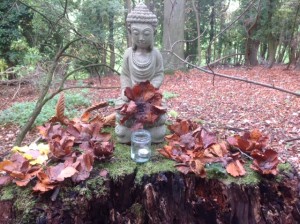
Photos (top to bottom): Our Forest School Buddha, Mountain class bees project, children enjoying Forest School.