

One of my Buddhist teachers, Martin Aylward, posted a picture of himself online this week in a smart suit. He was on his way to the Houses of Parliament to deliver (with others) the ‘landmark British report’, Mindful Nation UK. I want to share some of the details of this report and comment on it, from my position as the Head of a school with a Buddhist ethos at its heart.
Mindfulness has become such a buzzword in the news and appears to be permeating many areas of our lives. There are now more than 500 peer-reviewed research papers in journals (mostly in the fields of neuroscience and psychology) about its efficacy in different areas and with different groups of people. The Mindful Nation report has explored and made recommendations in four areas; health, education, the workplace and in the criminal justice system. I read the section on education with particular interest.
Jon Kabat-Zinn, the pioneer of mindfulness in a health context, wrote the foreword. In it, he describes mindfulness elegantly as ‘a way of being in wise and purposeful relationship with one’s experience, both inwardly and outwardly’. Also, ‘It is cultivated by systemically exercising one’s capacity for paying attention, on purpose, in the present moment, and non-judgementally, and by learning to inhabit and make us aware of the clarity, discernment, ethical understanding, and awareness that arise from tapping into one’s own deep and innate interior resources for learning, growing, healing, and transformation’. He talks about mindfulness as a window into seeing our minds; our thoughts and emotions, and also our ‘constraining assumptions and deeply conditioned habits of mind and behaviour’.
The positive impetus from mindfulness practitioners and Buddhist meditators is clear and is the core reason that I applied for the position of Head at the Dharma Primary School. Increasingly, there is concern for the mental well-being of young people in the UK. The statistics in this report really give cause for concern when taken on a nationwide level – around 10% of children experience mental health issues between the ages of five and 16 and 30% of English adolescents report sub-clinical mental health issues (which also impacts on their academic achievement). The incidence of depression in 15-16 year olds has doubled since the 1980s. In addition, over half of those who experience mental illness in childhood suffer it again as adults.
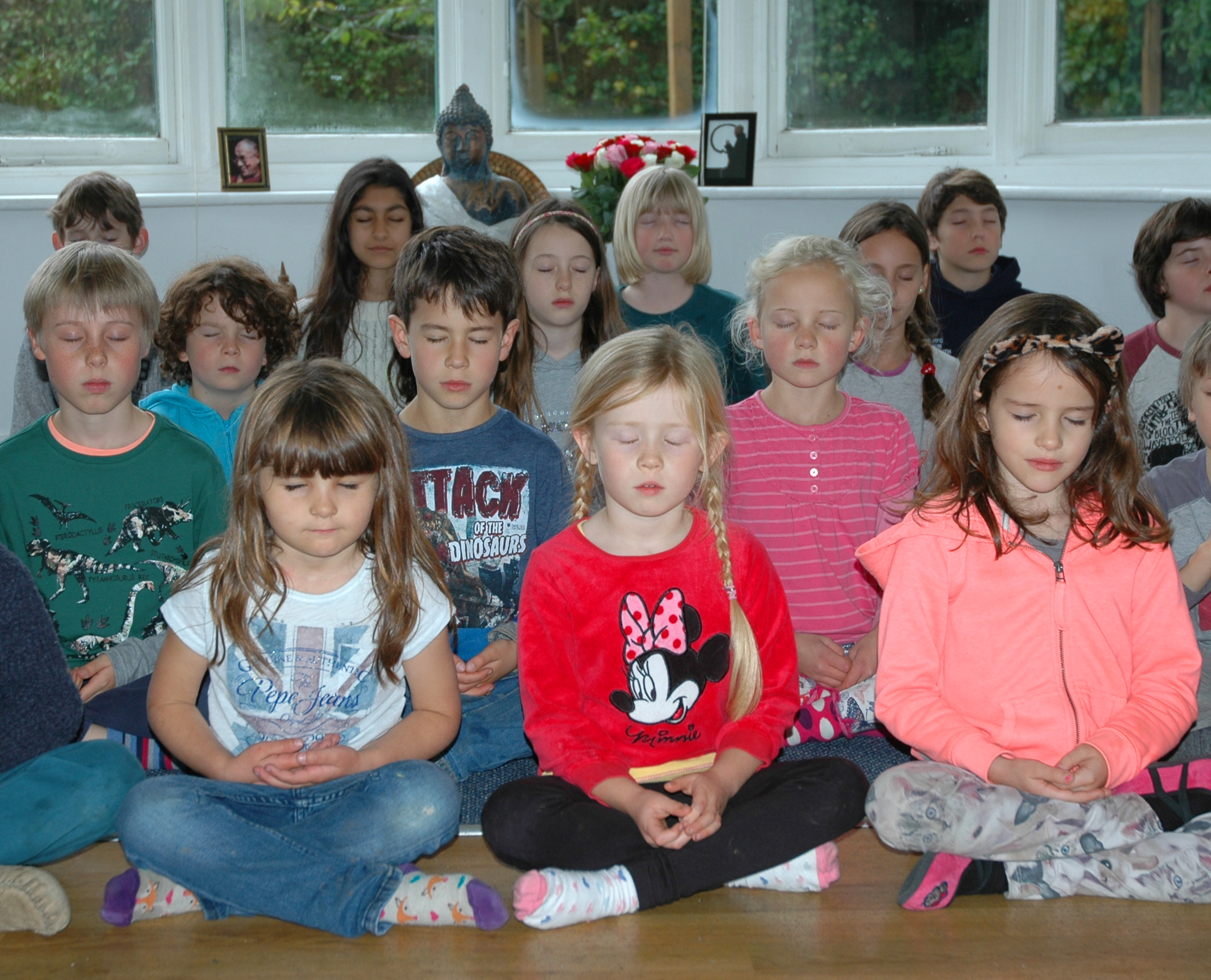
On a more positive note, mindfulness builds resilience and is proven to improve academic attainment, which has also been stated in the report. It allows young people to manage stress and self-regulate in a healthy way and improves ability to form constructive social relationships. I believe that sharing mindfulness practice with primary age children is extremely important, as at this age their brains are developing rapidly. With mental health issues in young people on the rise, it is essential to embed healthy habits of mind that will serve them well as they grow into young adults and cope with the stresses of modern life. The secular Mindfulness in Education movement has made great strides in this area, but where I think we differ in our approach as a school rooted in Buddhist principles, is that we are looking at mindfulness as a transformative process; one that develops compassion, empathy, loving kindness and ethical values, as well as a tool to reduce stress and improve learning. And we integrate it as a ‘whole school approach’.
The report talks about the success of mindfulness in a school depending to a ‘considerable extent’ on the quality and experience of the teachers’ own mindfulness practice and how this takes several years of sustained personal commitment. Also that it is more effective as a whole school approach that includes the entire community – staff and parents as well as children. We have a staff team committed to the Buddhist ethos and several people have many years of sustained meditative practice. Indeed, the school has has been dedicated to a mindful ethos for the past two decades and celebrated its 20th Anniversary last year. Of course a mindful approach requires an underpinning of ethics. We can and do model this effectively through the behaviour of teachers in relationship to children, in our approach to behaviour and in wider relationship with other staff members and parents.
On reading the report, I felt that our school is ahead of the curve and really has the potential to lead in this area. It is exciting to be able to link with and expand upon the mindfulness movement that is now so prevalent in education and to root it within the spiritual framework from where it originally emerged.